Qi’s paper is accepted at J Comput Phys
Qi Sun’s paper entitled, Improving the Robustness of the Immersed Interface Method through Regularized Velocity Reconstruction, which is co-authored by Amin Kolahdouz, has been accepted for publication in the Journal of Computational Physics.
This paper introduces a stabilization strategy for the immersed interface method that eliminates a restrictive mesh factor ratio requirement by using a Tikhonov-regularized velocity interpolation operator. The new formulation preserves accuracy while allowing the structure mesh to be much finer than the fluid grid, enabling stable and efficient simulations of complex fluid–structure interaction problems that were previously computationally prohibitive.
Congratulations, Qi!
Cole’s paper is accepted at J Comput Phys
Cole Gruninger’s paper entitled, Composite B-Spline Regularized Delta Functions for the Immersed Boundary Method: Divergence-Free Interpolation and Gradient-Preserving Force Spreading, has been accepted to appear in Journal of Computational Physics.
This paper introduces an immersed boundary method for fluid–structure interaction that employs composite B-spline regularized delta functions, which have been used previously to achieve pointwise divergence-free velocity reconstructions in computational fluid dynamics applications but not within immersed boundary formulations. The work is the first to demonstrate that these kernels preserve discrete gradient structure when spreading forces from a thin boundary to the background grid. This key conceptual advance explains their excellent volume conservation and shows that they achieve accuracy comparable to the nonlocal divergence-free immersed boundary (DFIB) method of Bao et al. while maintaining the locality and efficiency of the classical immersed boundary approach.
Congratulations, Cole!
Michael (Li)’s paper is accepted at PLoS Comput Biol
Lianxia (Michael) Li’s paper, with colleagues from the UNC Kidney Center and the Biomedical Research Imaging Center entitled, Temporal evolution of hemodynamics in murine arteriovenous fistula: A micro-CT based CFD study, has been accepted to appear in PLOS Computational Biology.
Congratulations, Michael!
Aaron’s paper is accepted at Comput Fluids
The paper by group alumnus Aaron Barrett, Adaptive mesh refinement for two-phase viscoelastic fluid mixture models, has been accepted for publication in Computers & Fluids. This study was also done in collaboration with Bindi Nagda and Jian Du at Florida Institute of Technology and Aaron Fogelson at the University of Utah.
Congratulations, Aaron!
Michael (Facci) and Amin’s paper is accepted at J Comput Phys
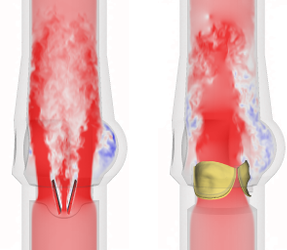
Michael (Facci) and group alumnus Amin Kolahdouz’s paper, An immersed interface method for incompressible flows and geometries with sharp features, has been accepted to appear in Journal of Computational Physics.
Congratuations, Michael and Amin!
Michael (Li) and Cole’s paper is accepted at Adv Comput Sci Eng
Lianxia (Michael) Li and Cole’s paper, with group alumnus Jae Ho (Mike) Lee, Local divergence-free immersed finite element-difference method using composite B-splines, has been accepted to appear in Advances in Computational Science and Engineering.
Congratulations, Michael, Cole, and Mike!
Kirsten’s paper is accepted at PLoS One
Kirsten’s paper, An anatomically informed computational fluid dynamics modeling approach for quantifying hemodynamics in the developing heart, has been accepted for publication in PLoS One. This study was also done in collaboration with Sophie Liu, group alumnus Simone Rossi, and the Bressan Lab at UNC-School of Medicine.
Congratulations, Kirsten!
Marshall and Charles’ paper is accepted at PNAS Nexus
Marshall Davey and Charles Puelz’s paper, which was co-authored by Simone Rossi, Margaret Anne Smith, and David Wells and entitled, Simulating cardiac fluid dynamics in the human heart, has been accepted for publication in PNAS Nexus. (An earlier preprint is available on arXiv.) The study was also performed in collaboration with Greg Sturgeon and Paul Segars at Duke, John Vavalle at UNC School of Medicine, and Charlie Peskin at NYU.
Predictive mathematical models of blood flow in the heart can simulate cardiac physiology, pathophysiology, and dysfunction along with responses to interventions. However, existing models of the heart are limited in their abilities to predict valve performance, use realistic descriptions of tissue biomechanics, or predict the response of the heart to changes in loading conditions. The integrative model of the human heart introduced in this paper aims to address these limitations. It generates pressure-volume loops, valvular pressure-flow relationships, and vortex formation times that are in excellent agreement with clinical and experimental data. The model also captures realistic changes in cardiac output in response to changing loading conditions. Critically, these physiologic aspects emerge inherently from mechanistic interactions within our comprehensive description of cardiac physiology.
This paper advances the state-of-the-art in modeling cardiac fluid-structure interaction.
Congratulations, Marshall, Charles, and the rest of the team!
Aaron and Cole’s paper is accepted at J Fluid Mech
The paper by group alumnus Aaron Barrett, along with Cole Gruninger, Flagellum pumping efficiency in shear-thinning viscoelastic fluids, has been accepted to appear in Journal of Fluid Mechanics. This study was also done in collaboration with Greg Forest at UNC and with Aaron Fogelson at the University of Utah.
Congratulations, Aaron and Cole!
Cole, Aaron, and Fuhui’s paper is accepted for publication in J Comput Phys
Cole Gruninger’s paper, with group alumni Aaron Barrett and Fuhui Fang and entitled, Benchmarking the immersed boundary method for viscoelastic flows, has been accepted to appear in Journal of Computational Physics. This study was also done in collaboration with Greg Forest at UNC.
Congratulations, Cole, Aaron, and Fuhui!
