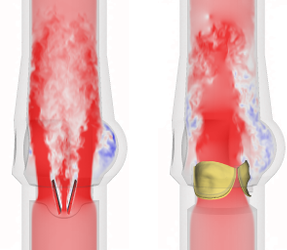
Keon’s paper is accepted for publication in J Comput Phys

August 24, 2023

Keon Kim’s paper, which is with group alumnus Amneet Bhalla and is entitled, An immersed peridynamics model of fluid-structure interaction accounting for material damage and failure, has been accepted to appear in Journal of Computational Physics.

Congratulations, Keon and Amneet!

Amin’s paper is accepted to J Comput Phys

April 18, 2023

The paper by group alumnus Amin Kolahdouz, along with David Wells and Simone Rossi, A sharp interface Lagrangian-Eulerian method for flexible-body fluid-structure interaction, has been accepted to appear in Journal of Computational Physics. This work was also done with our FDA collaborators Kenny Aycock and Brent Craven.

Congratulations, Amin, David, and Simone!

Aaron and Jordan’s paper is accepted for publication in Int J Numer Method Biomed Eng

February 21, 2023

The paper by group alumnus Aaron Barrett, along with Jordan Brown, A model of fluid–structure and biochemical interactions for applications to subclinical leaflet thrombosis, has been accepted to appear in International Journal for Numerical Methods in Biomedical Engineering. This study was also done in collaboration with John Vavalle at UNC, Arash Kheradvar at UC Irvine, and Aaron Fogelson at the University of Utah.

Congratulations, Aaron and Jordan!

David and Ben’s paper is accepted for publication in J Comput Phys

December 27, 2022

David Wells and Ben Vadala-Roth’s paper, which was also written with Mike Lee and is entitled, A nodal immersed finite element-finite difference method, has been accepted to appear in Journal of Computational Physics.

Congratulations, David, Ben, and Mike!

Jordan’s paper is accepted for publication in Ann Biomed Eng

August 4, 2022

Jordan Brown’s paper, Patient–Specific Immersed Finite Element–Difference Model of Transcatheter Aortic Valve Replacement, has been accepted to appear in Annals of Biomedical Engineering in their Special Issue on Modeling for Advancing Regulatory Science.

Congratulations, Jordan!

Mike’s paper is accepted for publication in J Comput Phys

February 2, 2022

Mike Lee’s paper, On the Lagrangian-Eulerian coupling in the immersed finite element/difference method, has been accepted to appear in Journal of Computational Physics. (A preprint is available on the arXiv.) This paper systematically tests the accuracy of the immersed finite element/difference method (IBFEMethod in IBAMR) using different regularized delta functions and relative mesh densities for several benchmark problems along with our large-scale model of a bioprosthetic heart valve in a pulse duplicator. Our results indicate that kernels satisfying a commonly imposed even–odd condition require higher resolution to achieve similar accuracy as kernels that do not satisfy this condition. We also find that narrower kernels are more robust, in the sense that they yield results that are less sensitive to relative changes in the Eulerian and Lagrangian mesh spacings, and that structural meshes that are substantially coarser than the Cartesian grid can yield high accuracy for shear-dominated cases but not for cases with large normal forces. I think this will be a very useful study for practitioners of the IB method.

Congratulations, Mike!

Aaron’s paper is accepted for publication in J Comput Phys

October 21, 2021

Aaron Barrett’s paper, A hybrid semi-Lagrangian cut cell method for advection-diffusion problems with Robin boundary conditions in moving domains, has been accepted to appear in Journal of Computational Physics. (A preprint is available on the arXiv.) This paper introduces a new discretization approach to advection-diffusion equations with Robin boundary conditions on complex time-dependent domains. This work is part of broader efforts to simulate thrombosis in atrial fibrillation and leaflet thrombosis following aortic heart valve replacement.

Congratulations, Aaron!

Saad’s paper is accepted for publication in J Comput Phys

April 27, 2021

Saad Qadeer’s paper, The smooth forcing extension method: A high-order technique for solving elliptic equations on complex domains, has been accepted to appear in Journal of Computational Physics. (A preprint is available on the arXiv.) This paper introduces a new high-order accurate approach, the smooth forcing extension method, to elliptic equations in complex geometries using Fourier continuation methods.

The smooth forcing extension method is similar to the immersed boundary smooth extension (IBSE) method introduced by Guy, Stein, Thomases, and co-workers, but it relies on extending the forcing term instead of the solution field from the “physical” to the “non-physical” domain. One consequence of this difference is that the smooth forcing extension method can yield a better conditioned system of equations than the IBSE formulation, which can yield improved accuracy at higher resolutions.

Congratulations, Saad!

Amin’s paper is accepted for publication in J Comput Phys

April 12, 2021

Amin Kolahdouz’s paper, A sharp interface Lagrangian-Eulerian method for rigid-body fluid-structure interaction, has been accepted to appear in Journal of Computational Physics. (A preprint is available on the arXiv.) This paper introduces a new sharp interface method to simulate fluid-structure interaction (FSI) involving rigid bodies immersed in viscous incompressible fluids by substantially extending Amin’s earlier work on immersed interface methods for discrete surfaces.

We refer to the numerical approach developed in this paper as an immersed Lagrangian-Eulerian (ILE) method. This ILE method integrates aspects of partitioned and immersed FSI formulations: it solves separate momentum equations for the fluid and solid subdomains, as in a partitioned formulation, while also using non-conforming discretizations of the dynamic fluid and structure regions, as in an immersed formulation.

An important aspect of the methodology is that, at least for all of the tests considered so far, it does not appear to suffer from so-called added mass effect instabilities. Indeed, tests suggest that it is capable of treating models with extremely small, nearly equal, equal, and large solid-fluid density ratios. The question of whether the ILE method does or does not suffer from the added mass effect awaits future analytical studies.

We are looking forward to future extensions and applications of this exciting new approach to FSI.

Congratulations, Amin!