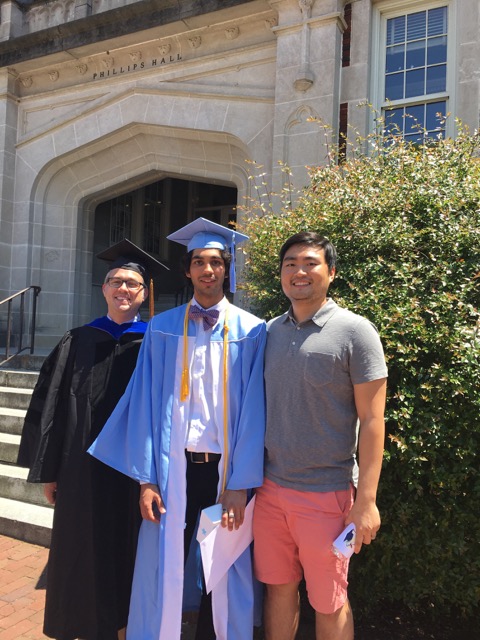
Congratulations to Drs. Fuhui Fang and Mike Lee!
Congratulations to Fuhui Fang and Mike Lee for successfully completing their PhDs.
Fuhui’s thesis is on Numerical Advances for Fluid-Structure Interactions in Entangled Polymer Solutions with Applications to Active Microbead Rheology. Fuhui will be starting a position at Microsoft in the Fall.
Mike’s thesis is on Simulating In Vitro Models of Cardiovascular Fluid-Structure Interaction: Methods, Models, and Applications. Mike is off to a postdoctoral position at Johns Hopkins in the Department of Mechanical Engineering and Institute for Computational Medicine.
Good luck, Fuhui and Mike!
Ben’s paper is accepted for publication in Computer Methods in Applied Mechanics and Engineering
Ben Vadala-Roth’s paper, Stabilization Approaches for the Hyperelastic Immersed Boundary Method for Problems of Large-Deformation Incompressible Elasticity, has been accepted to appear in Computer Methods in Applied Mechanics and Engineering. (A preprint is available on the arXiv.) This paper proposes a simple stabilization that resembles approaches from nearly incompressible solid mechanics to improve the volume conservation of the immersed finite element method, as demonstrated by its performance in widely used benchmark problems of incompressible hyperelasticity adapted from the solid mechanics literature, along with fully dynamic FSI applications, including a large-scale model of esophageal transport.
Congratulations, Ben!
Charles’ paper is accepted for publication in Journal of Computational Physics
Charles Puelz’s paper, A Sharp Interface Method for an Immersed Viscoelastic Solid, has been accepted to appear in Journal of Computational Physics. (A preprint is available on the arXiv.) This paper develops an extension of the hyperelastic immersed boundary method that sharply resolves pressure discontinuities at fluid-structure interfaces by modifying the definition of the elastic stress tensor associated with the hyperelastic material response. Unlike most other sharp-interface immersed boundary methods, however, this approach allows us to use standard discretization methods that are “oblivious” to the presence of the pressure discontinuity. Numerical tests show the impact of the method on the accuracy of the overall scheme, and an approach is developed that allows us to compute the splitting efficiently.
Congratulations, Charles!
Congratulations to Dr. Yanni Lai!
Congratulations to Yanni Lai for successfully completing her PhD. Yanni’s thesis was on Multigrid Methods for the Bidomain Equations. Yanni has already started a position at Amazon in Seattle. Good luck, Yanni!
Mike’s paper is accepted for publication in Annals of Biomedical Engineering
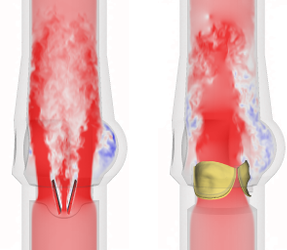
Mike’s paper, Fluid-Structure Interaction Models of Bioprosthetic Heart Valve Dynamics in an Experimental Pulse Duplicator, has been accepted to appear in Annals of Biomedical Engineering. (A preprint is available on engrXiv.) This paper uses IBAMR’s version of the immersed finite element method to simulate the dynamics of bioprosthetic heart valves (BHVs) in the aortic test section of experimental pulse duplicator systems. An initial experimental validation of the models is demonstrated through comparisons to data on pressures, flow rates, and leaflet kinematics. The paper also contrasts the flow patterns and leaflet strains and stresses generated by porcine tissue and bovine pericardial BHVs, and demonstrates the ability of the model to capture the large scale flow features.
Congratulations, Mike!
Ben Vadala-Roth completes his oral exam
Congratulations to Ben Vadala-Roth, who successfully completed his oral qualifying exam on stabilization methods that improve the accuracy of nonlinear solid mechanics formulations used in the immersed finite element method and their application to modeling bicuspid aortic valves!
Immersed methods review paper is in press at Annual Review of Fluid Mechanics
Our review paper with Neelesh Patankar (Northwestern) on immersed approaches to fluid-structure interaction is now in press at Annual Review of Fluid Mechanics.
Yanni Lai defends her PhD thesis
Congratulations to Yanni Lai for successfully defending her thesis, Multigrid Methods for the Bidomain Equations! Yanni is now finishing up some final revisions to her written thesis as the last step before completing her PhD requirements.
New NSF software infrastructure award
We are trilled to announce that we just received notification of a new $1.3M award through the NSF Cyberinfrastructure for Sustained Scientific Innovation program. This project will develop multiphase and low Mach number flow simulation capabilities in the IBAMR software and will re-engineer IBAMR to scale to 1000’s of cores and beyond. These capabilities will enable specific applications, including biological applications along with wave-energy converter devices and additive manufacturing (3D printing).
This is a collaborative project that will be carried out with teams of researchers at Northwestern University (PI: Neelesh Patankar), San Diego State University (PI: Amneet Bhalla), and University at Buffalo (PI: Matt Knepley).
Amin’s paper is accepted for publication in Journal of Computational Physics
Amin Kolahdouz’s paper, An immersed interface method for discrete surfaces, has been accepted to appear in the Journal of Computational Physics. (A preprint is available on the arXiv.) This paper develops an extension of the immersed interface method (IIM) that is specialized to discrete surface representations, such as triangulated surfaces. It also establishes through extensive numerical examples that IIMs that use only the lowest-order jump conditions (for the pressure and viscous shear stress) at immersed interfaces are able to yield global second-order convergence rates.
Congratulations, Amin!